When Growth Becomes the Enemy: How Scaling Up Can Quietly Scale You Out
Somewhere between your third client referral and your first hire, something shifts. The work that used to feel deeply personal starts feeling like a product. The decisions that once came from instinct now come from templates. And the clients who found you because your work felt different start getting something that feels a lot like everyone else's.
This is the quiet cost of scaling — and it catches a lot of creative professionals completely off guard.
The Allure of the System
There's a reason the word "scalable" gets thrown around like it's the holy grail of running a creative business. Systems are appealing. Repeatable processes mean less mental load, faster turnaround, and the ability to take on more clients without working yourself into the ground. It sounds like the smart move.
And honestly? For a lot of industries, it is.
But creative work operates on different rules. A brand identity, a website, an illustration series — these aren't widgets. The value isn't just in the deliverable. It's in the judgment, the intuition, the weird little decision you made at 11pm that turned the whole thing from fine into really good. That part doesn't fit neatly into a workflow doc.
When you build systems designed to replicate your process, you often end up replicating the surface of it — the steps, the deliverables, the file formats — while the soul of it quietly disappears.
What You're Actually Selling
Here's a question worth sitting with: what did your best clients actually hire you for?
Not the deliverable. Not the timeline. Not even your portfolio, really. They hired you because your work made them feel something — confident, seen, understood, excited. They hired you because your specific perspective on their problem was something they couldn't get from a template or a cheaper alternative.
That thing — that specific creative perspective — is almost impossible to systematize without diluting it. The moment you turn your approach into a repeatable formula, you're no longer offering your work. You're offering a version of your work that's been sanded down to fit a process.
And clients who came to you for the original? They'll notice.
The Trap of Efficiency
Efficiency is seductive, especially when you're exhausted and overbooked. But there's a difference between removing friction from your process and removing the depth from it.
Removing friction looks like: better contracts, clearer onboarding, a solid brief template, automated invoicing. None of that touches the creative work itself. It just clears the runway so you can actually focus on it.
Removing depth looks like: templated design systems applied without customization, junior work shipped without meaningful review, discovery calls that are really just checkbox exercises. That's not efficiency — that's erosion.
The creatives who scale badly tend to conflate the two. They optimize everything, including the parts that were never supposed to be optimized.
Selective Scaling: A Different Way to Grow
So what does healthy growth actually look like for a creative professional? It starts with being honest about which parts of your work are genuinely replicable and which parts are the whole point.
Protect the thinking. Your strategic process, your aesthetic judgment, your client conversations — these are where your value lives. They shouldn't be delegated or templated into oblivion. Build systems around them, not instead of them.
Scale the support, not the craft. Project management, client communication, file prep, revisions — there's real room to build systems here without touching what makes your work yours. Hire for support roles before you hire for creative roles, and be deliberate about what you hand off.
Say no to the work that doesn't need you. One of the most underrated growth strategies is simply turning away projects that don't require your specific skill set. If a client just needs something fast and cheap, you're not their person — and trying to be will pull your energy away from the clients who actually need what only you can do.
Charge more, take on less. This one feels counterintuitive until you do the math. Fewer clients at higher rates often means better work, more sustainable energy, and a business that actually survives long-term. Scaling up in price is almost always smarter than scaling up in volume for creative professionals.
The Handmade Advantage
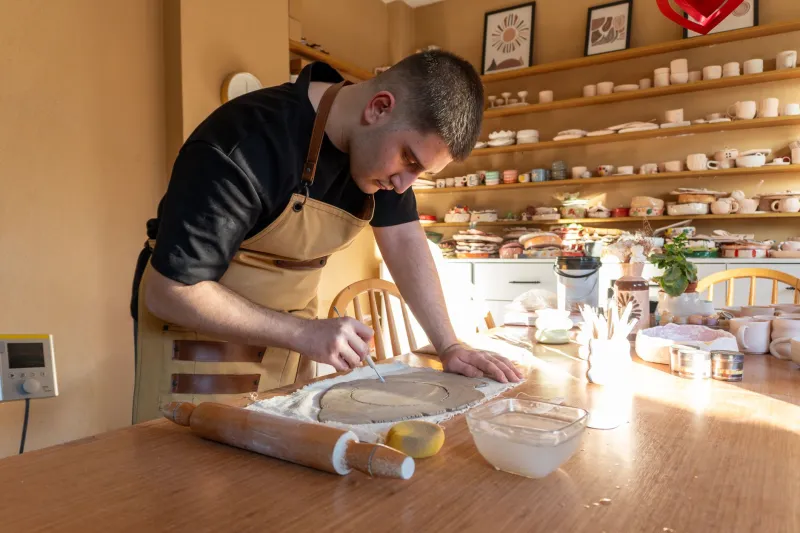
There's a reason people still pay a premium for handmade goods in a world drowning in mass production. It's not just nostalgia — it's the recognition that something made with real care and attention carries a quality that manufactured things don't.
Your creative work is the same. In a market full of AI-generated content, template-driven design, and fast-cheap-good-pick-two agencies, the creatives who are doubling down on genuine craft are increasingly rare. That rarity has value.
The pressure to scale often comes from comparing yourself to businesses that are built on volume. But if your business is built on quality — on the specific, irreplaceable thing you bring to every project — then volume is never going to be your competitive advantage anyway.
Growing Without Disappearing
None of this means you can't build a real, sustainable business. You absolutely can. But the path there looks different for a creative professional than it does for a SaaS company or a product brand.
Your version of growth might be raising your rates until your calendar has breathing room. It might be building a small, tight team where you stay close to the creative work. It might be developing a signature offering that's premium-priced and deeply considered rather than a menu of services designed to capture every possible client.
What it probably isn't is a fully automated client pipeline that runs without you. Because the moment you're truly removed from the work, you're not really selling your work anymore.
The goal isn't to scale your creativity. It's to protect it — and build a business sturdy enough to sustain it for the long haul.
That's a harder thing to build than a system. But it's a much better thing to have.